A R T I S T
Gustav Klimt (July 14, 1862 – February 6, 1918) was an Austrian Symbolist painter and one of the most prominent members of the Wiener Sezession (Vienna Secession) movement. His major works include paintings, murals, sketches, and other art objects, many of which are on display in the Vienna Secession gallery. Klimt's primary subject was the female body, and most of his works are marked by frank eroticism.
Klimt was born in Baumgarten, near Vienna, the second of seven children. His father, Ernst Klimt, formerly from Bohemia, was a gold engraver. Ernst married Anna Klimt (née Finster), whose unrealized ambition was to be a musical performer. Klimt lived in poverty for most of his childhood, as work was scarce and the economy difficult for immigrants. In 1876, Klimt was enrolled in the Vienna School of Arts and Crafts (Kunstgewerbeschule), where he studied until 1883, and received training as an architectural painter. Klimt became one of the founding members and president of the Wiener Sezession in 1897 and of the group's periodical Ver Sacrum (Sacred Spring).
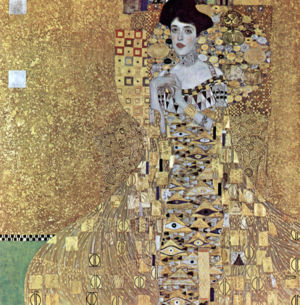
Klimt's "Golden Phase" was marked by positive critical reaction and success. Many of his paintings from this period utilized gold leaf; the prominent use of gold can first be traced back to Pallas Athene (1898) and Judith I (1901), although the works most popularly associated with this period are the Portrait of Adele Bloch-Bauer I (1907) and The Kiss (1907 - 1908). Klimt traveled little but trips to Venice and Ravenna, both famous for their beautiful mosaics, likely inspired his gold technique and his Byzantine imagery. In 1904, he collaborated with other artists on the lavish Palais Stoclet, the home of a wealthy Belgian industrialist, which was one of the grandest monuments of the Art Nouveau age. Klimt's contributions to the dining room, including both Fulfillment and Expectation, were some of his finest decorative work, and as he publicly stated, "probably the ultimate stage of my development of ornament."
Klimt's paintings have brought some of the highest prices recorded for individual works of art. In November 2003, Klimt's Landhaus am Attersee sold for $29,128,000, but that was soon eclipsed by prices paid for other Klimts. In 2006, the artist's Apple Tree I (ca. 1912) sold for $33 million and Birch Forest (1903) sold for $40.3 million. Both works had been recently restituted to the heirs of Adele Bloch-Bauer.
Purchased for the Neue Galerie in New York by Ronald Lauder for a reported US $135 million, the 1907 portrait Adele Bloch-Bauer I deposed Picasso's 1905 Boy With a Pipe as the highest reported price ever paid for a piece of art sold at a public auction, on or around June 19, 2006. On August 7, 2006, Christie's auction house announced it was handling the sale of the remaining works by Klimt that were recovered by the Bloch-Bauer heirs after a long legal battle. They auctioned Portrait of Adele Bloch-Bauer II in November 2006 for $88 million, the third-highest priced piece of art at auction at the time. Collectively, the five restituted paintings, including aforementioned landscapes, netted over $327 million.
(All information adapted from Wikipedia.)
